

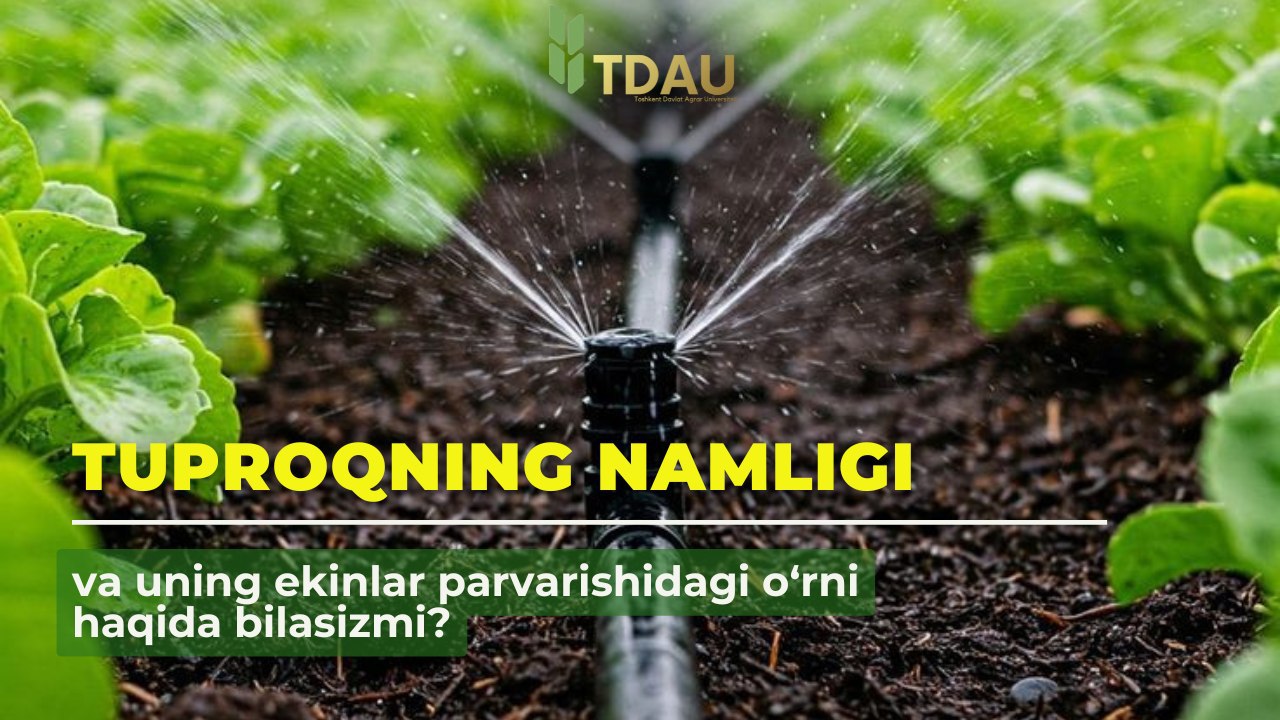
The mechanical properties of soil are considered to be closely related to soil moisture. Soil moisture is expressed as a percentage of the mass of absolutely dry soil or as a fraction of a unit.
In plant cultivation, soil moisture is a dynamic indicator and depends on the mechanical composition of the soil, the type and stage of plant development, the irrigation regime, and evapotranspiration.
Soil moisture is characterized by several indicators:
Soil moisture at full water saturation — the amount of water in the soil when all pores are completely filled with water;
Moisture at field capacity — the amount of water remaining in the soil after gravitational water has drained under the force of gravity. It reflects the soil’s ability to retain water;
Wilting point moisture — the amount of water in the soil equal to the minimum moisture required for plant survival. When moisture decreases below this level, plants begin to wilt;
Hygroscopic moisture of the soil — a level of moisture that cannot be absorbed by plants. Hygroscopic water is the water adsorbed on the surface of soil particles. The ability of soil to absorb water vapor from the air is called hygroscopicity, and the moisture absorbed in this way is called hygroscopic water;
Soil moisture between field capacity and the wilting point is considered available moisture for plants. The amount of water constituting soil moisture is expressed as a percentage of the total soil volume and is referred to as volumetric soil moisture.
Social networks: