


Professor Ch.I. Bekkamov
Tashkent State Agrarian University, Faculty of Zooengineering, Department of Sericulture and Moriculture
The growing global demand for natural products and textiles made from them in major developed countries requires the production of high-quality natural raw materials that meet the requirements of agriculture, the global market, and industrial enterprises. This, in turn, significantly increases the demand for natural products derived from silkworms in the sericulture sector and enhances economic efficiency. Advanced nations with highly developed science and industry in sericulture, such as the People's Republic of China, India, Uzbekistan, Japan, Vietnam, South Korea, Brazil, Bulgaria, Egypt, and Madagascar, are paying special attention to the rapid acceleration and development of this field.
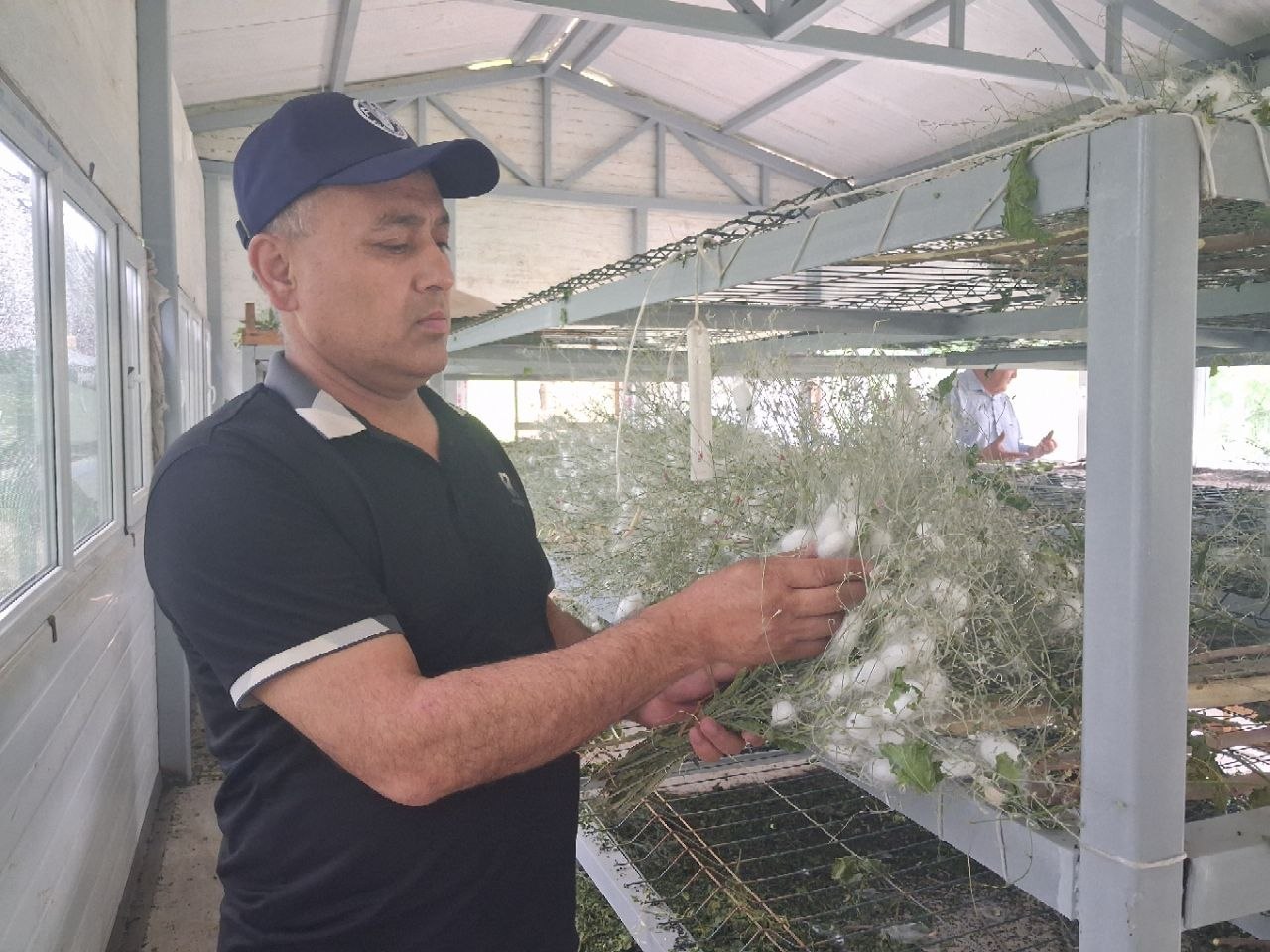
In these countries, the production of essential industrial and consumer goods such as food, perfumery, pharmaceuticals, and natural silk fabrics from silkworm larvae, pupae, moths, and cocoons has been identified as a critical contemporary task. Our republic ranks third globally in cocoon raw material production, following the People's Republic of China and India. Along with being a high-export-potential sector of our country’s agriculture, this industry plays a crucial role in providing employment for the rural population and increasing their sources of income.
In this regard, since the early years of independence, and particularly in New Uzbekistan, the President and the Cabinet of Ministers of the Republic of Uzbekistan have paid immense attention to further deep structural reforms and the comprehensive, industrial-based development of sericulture. To widely introduce innovative ideas and scientific achievements into production and to ensure the continuity of qualified personnel in the industry, the Resolution of the President of the Republic of Uzbekistan No. PP-3472 "On measures for further development of the sericulture industry in the republic" was adopted on January 12, 2018. This resolution established several important tasks, including attracting foreign investment into the sericulture sector, transferring existing mulberry plantations to regional "Agropilla" LLCs, strengthening the integration of science and education to assess the industry's need for higher education graduates across regions, and systematically training highly qualified specialists while upskilling the existing workforce.
In particular, the Resolution of the President of the Republic of Uzbekistan No. PP-135 dated April 11, 2026, "On additional measures to improve the activities of Tashkent State Agrarian University," is of great importance for training highly qualified and competitive specialists for the agricultural sector, elevating the agrarian education system to a qualitatively new level, introducing advanced educational technologies into the teaching process, and enhancing educational quality and scientific potential. Furthermore, it aims to train young professionals who meet modern demands by integrating science, education, and production. The deployment of new breeds, hybrids, and mulberry varieties developed by our leading scientists, the introduction of new equipment and technologies, the opening of part-time (correspondence) departments in sericulture at higher education institutions from the 2019-2020 academic year, the launch of evening and distance learning formats from the 2025-2026 academic year, and the organization of dual education systems at advanced production enterprises are designed to fully meet the industry's demand for qualified personnel.
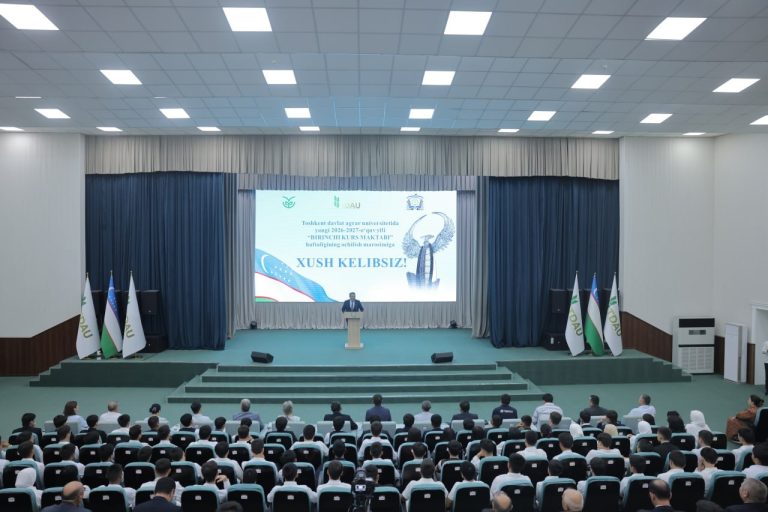
Consequently, the leadership and faculty of Tashkent State Agrarian University have organized highly effective initiatives within the core educational curriculum to cultivate competitive, mature, and well-trained personnel. In the "Sericulture and Moriculture" educational direction, the training system has been optimized based on three-year curricula, comprehensive State Educational Standards, qualification requirements, course syllabi, and curriculum subject designs. The active operation of the HEMIS platform has been secured, project offices have been established, and the implementation of innovative ideas and startup projects by gifted students has been streamlined. Evaluating the university’s performance at the departmental level highlights exemplary progress in creating educational-methodological materials based on new modules, methodological guidelines, manuals, and next-generation textbooks.
Simultaneously, the advanced experiences of countries with highly developed sericulture industries, such as China, Japan, India, Vietnam, South Korea, and Italy, are being studied and integrated into the educational process. The enrollment of students in joint degree programs, their deployment to practical internships, and the overseas professional development fellowships for faculty members stand out as positive outcomes.
Most importantly, practical measures are being carried out to implement the tasks specified in the Resolution of the President of the Republic of Uzbekistan No. PP-273 dated June 7, 2022, "On additional measures for the effective organization of the implementation of tasks set out in the Strategy for the Development of Agriculture of the Republic of Uzbekistan for 2020–2030," and the Decree of the President of the Republic of Uzbekistan No. PF-72 dated May 3, 2024, "On additional measures to accelerate the introduction of market mechanisms in the cocoon production and sericulture sector," alongside other relevant regulatory and legal frameworks. These efforts are aimed at enhancing the sector’s attractiveness, applying modern technologies, utilizing resource-saving agrotechnologies efficiently, and widely implementing innovative ideas and scientific advancements to increase cocoon yields by strengthening the sericulture feed base and expanding the volume of export-oriented products.
Furthermore, the official resolutions outline mechanisms to ensure the execution of reforms in the sericulture sector and provide step-by-step oversight for their implementation:
Free distribution of mulberry saplings for renewing plantations and silkworm seeds (graine) for cocoon production seasons to the population by sericulture organizations;
Retaining all income generated by the population from selling cocoons, as well as from cultivation of additional seasonal agricultural crops planted between the rows of specialized fodder mulberry plantations, entirely in their own possession;
Increasing public responsibility for maintaining the integrity of specialized fodder mulberry trees, improving leaf yields, cultivating and utilizing highly nutritious leaves, and setting specific production output requirements during the agrotechnical process of silkworm rearing to foster the prospective development of the industry;
Ensuring the employment of unemployed women, attracting leading women into the industry, and boosting entrepreneurship by strengthening cottage industry (handicraft/home-based work) activities;
Supporting young peoples' new ideas and innovative initiatives in the agrarian sector, and building a startup ecosystem for youth in higher and professional educational organizations;
Implementing the "Farmers of the Future" initiative starting from the 2026-2027 academic year to prepare students of Tashkent State Agrarian University as specialists equipped with extensive practical knowledge in the agricultural sector.
As concrete evidence of these initiatives, systematic efforts are being carried out across all provinces to attract unemployed women and women leaders to the industry. This is conducted through a collaborative partnership between the Agency for Light Industry Development under the Cabinet of Ministers of the Republic of Uzbekistan, the "Uzbekipaksanoat" Association, the Committee for Family and Women, and the Sericulture Research Institute, in fulfillment of the Cabinet of Ministers’ Resolution No. 46 dated January 29, 2025, "On measures for the gradual provision of employment for women in the sericulture sector."
In conclusion, it is worth emphasizing that the state policy currently being implemented for the comprehensive development of the sericulture sector in our republic will yield highly positive results in the near future. It will serve to further deepen structural reforms in the sericulture industry, establish an optimal system for training highly qualified personnel for rapid growth, improve the production cluster system, and expand specialized fodder mulberry plantations. The adoption of water-saving irrigation technologies in moriculture, the application of modern smart agrotechnologies, and the broad integration of innovative ideas and scientific achievements will collectively facilitate the cultivation of high-quality, globally competitive raw cocoon materials. This will expand the manufacturing of finished silk products under the authentic "Uzbek Brand," enabling the nation to secure prestigious positions in the global community and enhance the overall economic attractiveness of the sericulture industry.
LIST OF USED LITERATURE
Resolution of the President of the Republic of Uzbekistan dated January 12, 2018, No. PP-3472 "On measures for further development of the sericulture industry in the republic", Tashkent – 2018.
Resolution of the President of the Republic of Uzbekistan dated August 20, 2018, No. PP-3910 "On measures for more effective utilization of available opportunities in the sericulture industry of the republic", Tashkent – 2018.
Resolution of the President of the Republic of Uzbekistan dated December 4, 2018, No. PP-4047 "On additional measures to support the accelerated development of the sericulture industry in the republic", Tashkent – 2018.
Resolution of the President of the Republic of Uzbekistan dated July 31, 2019, No. PP-4411 "On additional measures for the development of deep processing in the sericulture industry", Tashkent – 2019.
Resolution of the President of the Republic of Uzbekistan dated January 17, 2020, No. PP-4567 "On measures for developing the silkworm feed base in the sericulture industry", Tashkent – 2020.
Resolution of the President of the Republic of Uzbekistan dated June 7, 2022, No. PP-273 "On additional measures for the effective organization of the implementation of tasks set out in the Strategy for the Development of Agriculture of the Republic of Uzbekistan for 2020–2030."
Resolution of the President of the Republic of Uzbekistan dated November 29, 2024, No. PP-410 "On additional measures to accelerate the comprehensive socio-economic development of the sericulture sector", Tashkent – 2024.
Decree of the President of the Republic of Uzbekistan dated May 3, 2024, No. PF-72 "On additional measures to accelerate the introduction of market mechanisms in the cocoon production and sericulture sector."
Resolution of the Cabinet of Ministers of the Republic of Uzbekistan dated January 29, 2025, No. 46 "On measures for the gradual provision of employment for women in the sericulture sector."
Resolution of the President of the Republic of Uzbekistan dated April 11, 2026, No. PP-135 "On additional measures to improve the activities of Tashkent State Agrarian University."
Bekkamov Ch.I., Daniyarov U.T., Rajabov N.O., Abdikayumova N.K. Sericulture and Moriculture. – Tashkent: "Cholpon" Publishing House, 2018. – Textbook.
Bekkamov Ch.I. Introduction to the Specialty. – Tashkent: "Xalq" Publishing House, 2024. – Textbook.
Bekkamov Ch.I. Fundamentals of Sericulture (Translated into Russian and English). – Tashkent: "Ideal-Press", 2025. – Study Guide.
Social networks: