

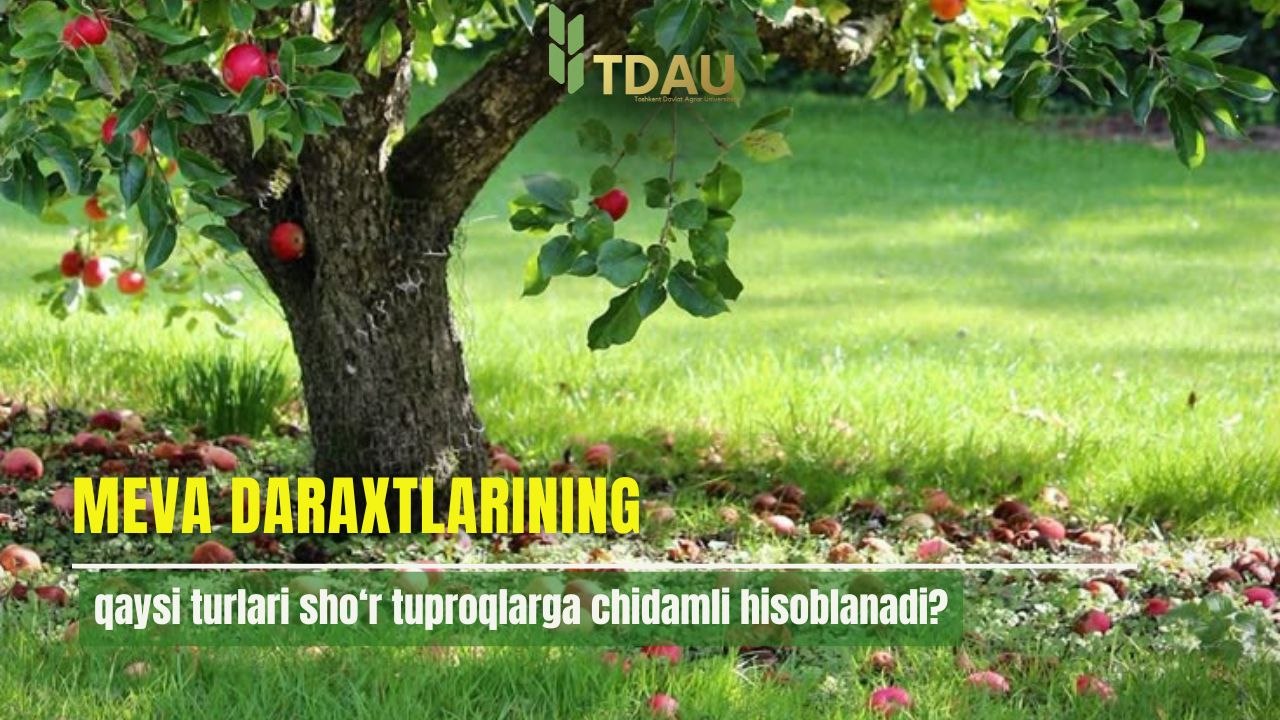
The salt tolerance of fruit trees largely depends on their species, variety, individual characteristics, and rootstocks. Under conditions of fertile soil and the application of organic fertilizers, fruit trees can withstand considerably high levels of salinity.
Different varieties of apple trees have varying degrees of resistance to chloride. For instance, the Turkmen apple is considered salt-tolerant. The "Simirenko" variety is less resistant, while "Rosmarin" varieties exhibit significant salt tolerance.
Pear trees are generally more salt-tolerant than apple trees. Local pear varieties frequently cultivated in the Khorezm region, such as olmurut and shakar-murut, are highly resistant to soil salinity.
Apricot is among the salt-tolerant fruit species, though it typically ranks below the pear in this regard. However, there are local apricot varieties that are even more salt-tolerant than pears. These include Qizilpolvon, Kuzgi, Xorazmiy, Oqpayvandi, Qoraqalpoq, and the Khiva dark-orange varieties.
Plum trees follow apricots in terms of soil salinity tolerance. The black plum, known locally in Khorezm as tanosul, and the apricot-cherry plum hybrid are exceptionally resistant to soil salinity.
Sweet cherries cannot be considered more resistant than sour cherries. The same applies to peaches. Figs and pomegranates are relatively salt-tolerant. Persimmons can also be classified among the resistant species. Strawberries, however, are not noteworthy in this regard; they are highly sensitive to salinity.
Social networks: