


TDAU Scientists’ “Toshkent” Mandarin Variety — A Significant Achievement in Domestic Citrus Breeding
Today, one of the key priorities in agriculture is the development of high-yielding varieties capable of replacing imports and adapting to local climatic conditions. In this regard, the “Toshkent” mandarin variety, developed by scientists of Tashkent State Agrarian University, is recognized as a remarkable achievement of domestic plant breeding.
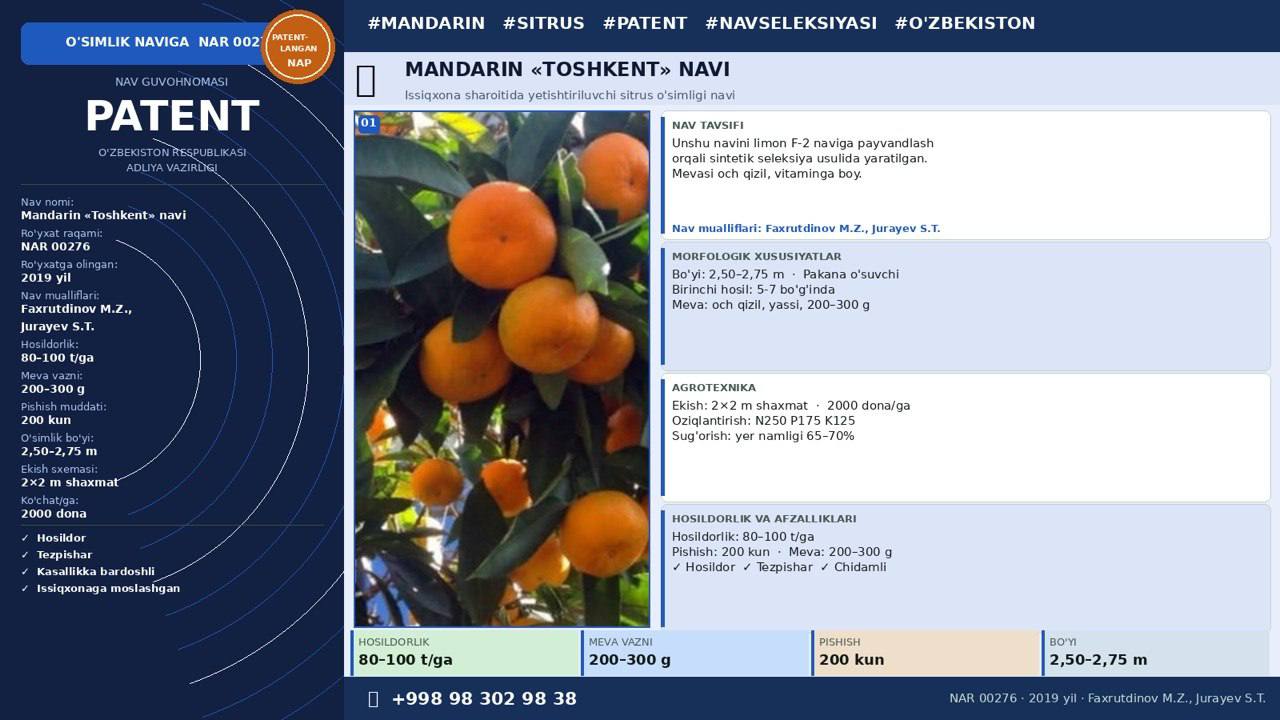
This variety was created as a result of many years of scientific research conducted at the experimental fields of Tashkent State Agrarian University. The authors of the variety are Prof. M.Z. Faxrutdinov and Prof. S.T. Jurayev. Using a synthetic breeding method based on grafting the Unshu variety in the F-2 generation, the researchers developed a new and promising mandarin variety.
The “Toshkent” mandarin variety was officially registered in 2019 and protected under Patent No. NAP 00276. This confirms both its scientific novelty and practical significance.
According to specialists, the variety is well adapted to greenhouse cultivation. The tree reaches a height of 2.5–2.75 meters. Its compact growth habit makes maintenance and harvesting more convenient. The vegetation period lasts about 200 days, and the first harvest is usually obtained within 5–7 years.
One of the main advantages of the variety is its high productivity. Under proper agronomic practices, it can yield 80–100 tons per hectare. The fruits are light reddish-orange in color, flattened in shape, and weigh between 200 and 300 grams. In addition, they are rich in vitamins, particularly vitamin C.
Social networks: